Affordability in America: Consumers' savings strategies vary by income


A majority (61%) of U.S. consumers are concerned about inflation. But the impact of rising prices isn’t felt evenly across all consumers: 64% of lower-income consumers completely agree they are focused more on buying what they need versus what they want, compared to 48% of higher income consumers.
How are consumers stretching their wallets? Nearly 40% claim to be trying to spend less overall, led by lower-income consumers at 46%, followed by middle-income consumers at 38% and higher-income consumers at 31%. Read on to find out more about how income influences consumers’ savings strategies.
Lower-income consumers are more willing to trade down
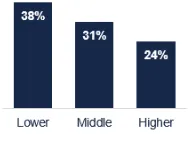
Nearly four in 10 (38%) of lower-income consumers completely agree they are willing to trade down on quality to save money on purchases, compared to 24% of higher-income consumers.
Trading quality for price
Sales-seeking is consistent across income groups
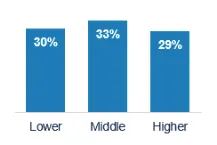
31% of consumers across income groups are shopping for sales and promotions more often. Here, middle-income consumers hold a slight lead at 33% while lower- and higher-income groups are at or near 30%.
Seeking sales and promotions
Middle- and higher-income consumers are more likely to delay large purchases
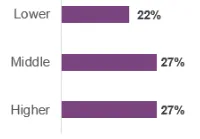
Middle- (27%) and higher-income (27%) consumers lead in delaying a major purchase (e.g., purchasing a car, furniture, home improvement, etc.).
Delaying large purchases
Key takeaway: Understand which savings lever your customers are using
Brands shouldn’t assume that higher income equates to a willingness to spend or that discounts only appeal to lower-income shoppers. The key is to tap into your customers’ savings behaviors. Consider testing different offers to see which are more successful at driving incremental sales across your customer base. Where appropriate, focus on long-term value messaging and offer transparent payment choices to reduce consumer hesitancy, particularly in the big-ticket space.
Source: Bread Financial proprietary study, Consumers & Payments, October 2026.
Note: Lower income = $0 - $49,999 in annual HHI; Middle income = $50,000 - $149,999 in annual HHI; Higher income = $150,000+ in annual HHI
About Bread Financial®
Bread Financial® (NYSE: BFH) is a tech-forward financial services company that provides simple, personalized payment, lending and saving solutions to millions of U.S. consumers. Our payment solutions deliver growth for some of the most recognized brands in travel & entertainment, health & beauty, technology, electronics, jewelry, home and specialty apparel through our co-brand and private label credit cards and pay-over-time products providing choice and value to our shared customers. Additionally, we offer Bread Financial general purpose credit cards and saving products that empower our customers and their passions for a better life.
Bread Financial proudly marks 30 years of success in 2026. To learn more about our global associates, our performance and our sustainability progress, visit breadfinancial.com or follow us on Instagram and LinkedIn.